Higher Education Research and Development Society of Australasia

You are here
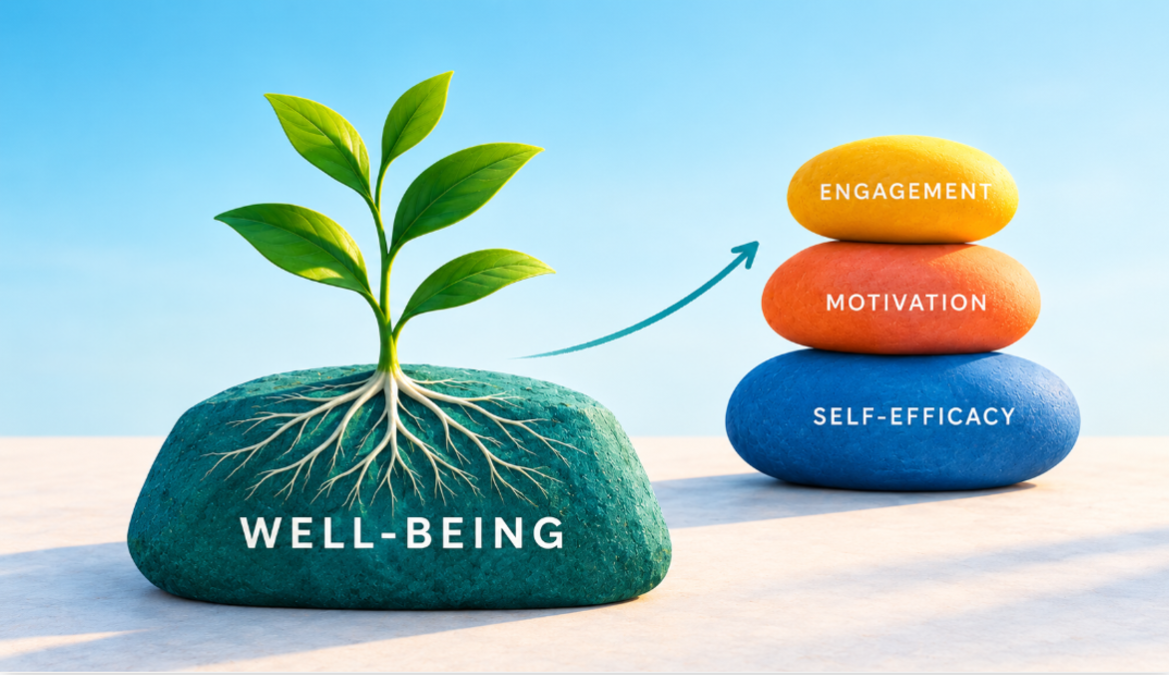
As university educators we want our students to be motivated. To fuel their motivation we redesign assessments, embed active learning approaches, and search for ways to increase engagement. But what if we’re jumping the gun here? Maybe motivation isn't the place to start. Maybe there’s something even deeper and more foundational that’s the key to unlocking student engagement and meaningful learning.
Well-being as a foundational requirement
While studying a large cohort of biomedicine students, we found that well-being was associated with intrinsic motivation (driven by internal rewards, interest and growth, rather than by extrinsic drivers, such as marks and the expectations of others) and self-efficacy. Not only that, well-being appeared to be a prerequisite for the development of both intrinsic motivation and self-efficacy in a learning context.
For students who did not have a high level of well-being, it was very uncommon for them to develop intrinsic motivation or self-efficacy, let alone both.
This points to the fact that well-being plays a vital role in supporting students to develop self-sustaining intrinsic drive and to engage meaningfully in self-efficacious learning.
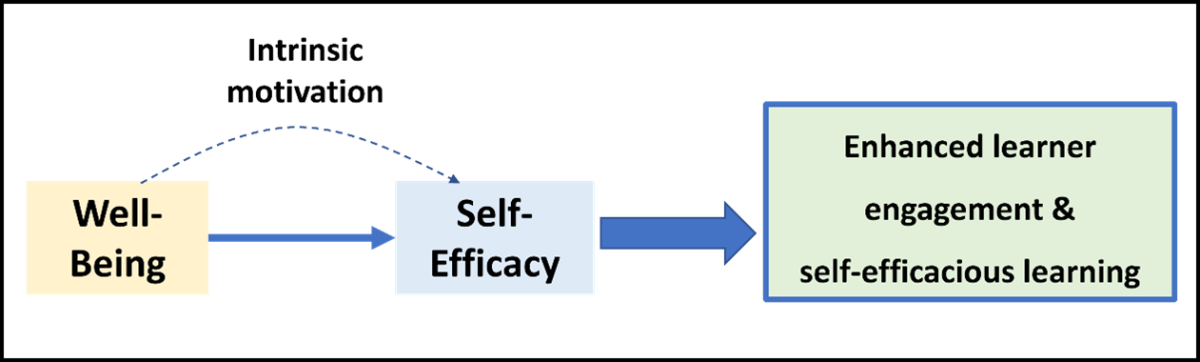
Let’s now consider these findings through the lens of Self-Determination Theory (SDT). Once the learner has autonomy, competence, and relatedness, they are in the position to develop intrinsic motivation. Not only that, these SDT factors are positively associated with well-being. So, by building learning experiences that support autonomy, competence, and relatedness, we can simultaneously assist students to increase their well-being and intrinsic motivation.
Supporting well-being in higher education
So, we’ve established that well-being helps support intrinsic motivation and self-efficacy. But how might we optimise learning environments and assessments to cultivate these factors, particularly well-being?
The first thing to acknowledge is that well-being initiatives should not only be limited to the periphery of the educational experience. Instead, they should be embedded into the learning environments and teaching practices.
Embedding well-being within the assessment & feedback approach
Well-being can be supported through designing assessments which actively promote autonomy, competence and relatedness. Some ways we can enhance these factors in the context of an assessment include:
- Providing students with more choice relating to topics they encounter in their assessments (autonomy)
- Scaffolding the assessment to build competence over time
- Providing opportunities to meaningfully interact with peers in the process of creating the assessment (relatedness)
Feedback practices can also be used to help foster well-being by:
- Providing the support students need to improve with feedback prior to the final submission
- Providing both positive and constructive feedback, while providing genuine guidance on how to improve
- Using audio or video feedback to enhance the connection between the educator and the student (relatedness)
Study strategies that promote well-being & effective learning
Another place we can support our students’ well-being is modelling effective study strategies that support both well-being and effective learning. This could include discussing approaches to time management, managing workload, normalising help-seeking, and developing approaches to study which support balance and mental well-being.
Promoting well-being in the learning environment
As learning usually involves interacting with unfamiliar ideas and challenges, there is a need to ensure that learners feel “safe”. This allows learners to engage in their studies without fear of judgement. Such an environment can be cultivated by encouraging students to ask questions, providing strategies to work through uncertainty, and promoting a non-judgemental environment where students feel that they can make mistakes.
Additionally, by providing opportunities for learners to connect and work together, we can foster belonging in the learning environment. It has been established that student belonging supports well-being, so fostering belonging is a great place to start.
After seeing just how important well-being is to student learning, I myself have redesigned a number of assessment tasks to better promote autonomy, competence, and relatedness. The engagement and buy-in for these assessments have increased dramatically, while continuing to support knowledge and skill development. For further details of this assessment redesign, see an earlier HERDSA Connect Blog post titled “Real voices real choices: Redesigning Assessment with autonomy and authenticity”.
Supporting Well-being in your own practice
So, before asking how we can motivate students to improve engagement, perhaps we should first ask whether our learning environments support the well-being that motivation depends on.
I invite you to take a moment to consider how your current educational practices are supporting student well-being and their growth as people.
What’s one thing that you could change to better support student well-being in your courses?
This blog is based on a recent publication in IJISME (Andrews et al. 2025)
Banner image generated by ChatGPT
About the author

Daniel Andrews
The HERDSA Connect Blog offers comment and discussion on higher education issues; provides information about relevant publications, programs and research and celebrates the achievements of our HERDSA members.
HERDSA Connect links members of the HERDSA community in Australasia and beyond by sharing branch activities, member perspectives and achievements, book reviews, comments on contemporary issues in higher education, and conference reflections.
Members are encouraged to respond to articles and engage in ongoing discussion relevant to higher education and aligned to HERDSA’s values and mission. Contact Daniel Andrews Daniel.Andrews@herdsa.org.au to propose a blog post for the HERDSA Connect blog.
HERDSA members can login to comment and subscribe.