Higher Education Research and Development Society of Australasia

You are here

Education is at a consequential point of transition. Artificial intelligence is extending what technology can do and simultaneously challenging long-held assumptions about knowledge, learning, assessment and human capability. As the possibilities expand and the pressure to respond intensifies, there is a risk that our attention becomes fixed on the capabilities of AI rather than the purposes of education.
The consequential questions lie elsewhere. What knowledge and capabilities should we continue to value? What does it mean to be educated in an AI-enabled world? What should remain distinctly human in learning and how do our choices today impact future generations?
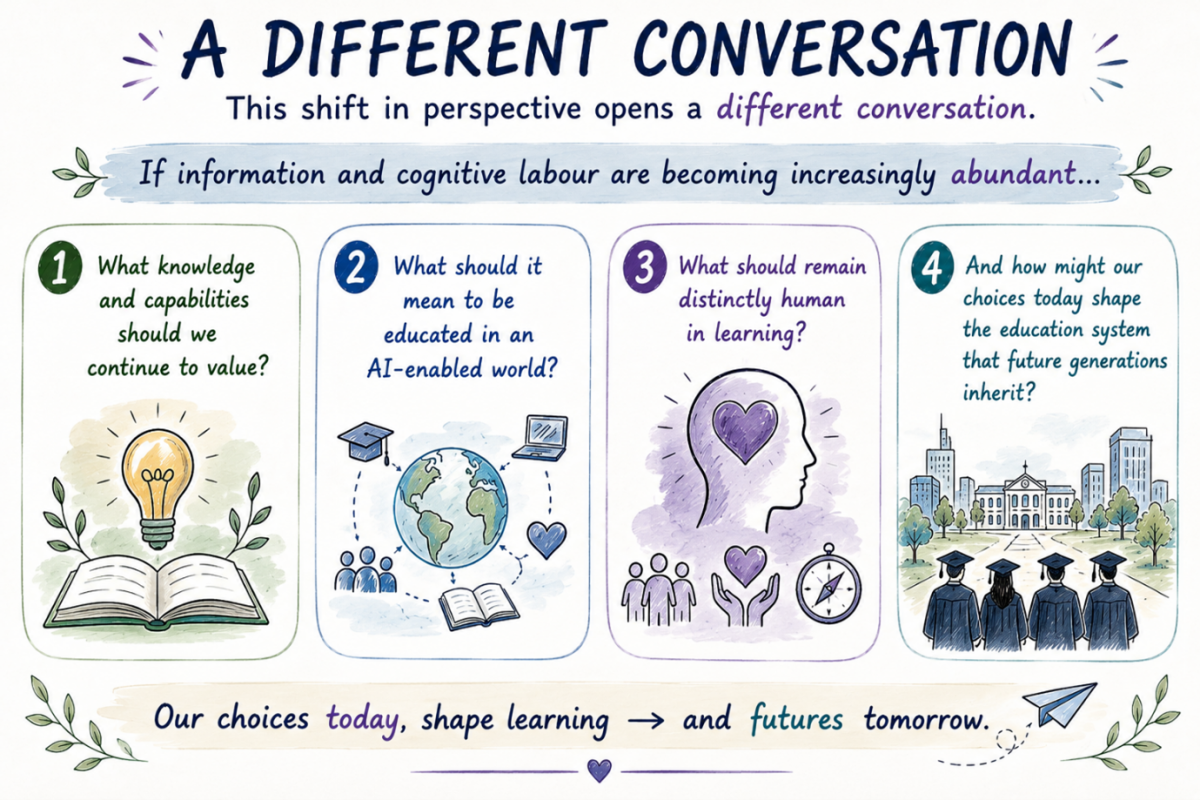
These questions provided a compelling foundation for the HERDSA 2026 workshop Exploring the Castlereagh Statement: Implications for AI, Education and Society. Professor Jason Lodge and Professor Edward Palmer drew participants into the ideas underpinning the Castlereagh Statement, positioning it not as a definitive response to the complexities of AI, but as an open invitation to reconsider the values, capabilities and purposes that should guide the future of education.
Rather than prescribing a singular solution for AI in education, the Castlereagh Statement articulates three national goals and six foundational principles, creating a shared foundation from which education can evolve. What is striking across this architecture is the prominence afforded to the human dimensions of education. The Statement foregrounds curiosity, adaptability and creativity; discernment and judgement; learning how to learn; deep disciplinary understanding; and the relational foundations through which meaningful learning occurs.
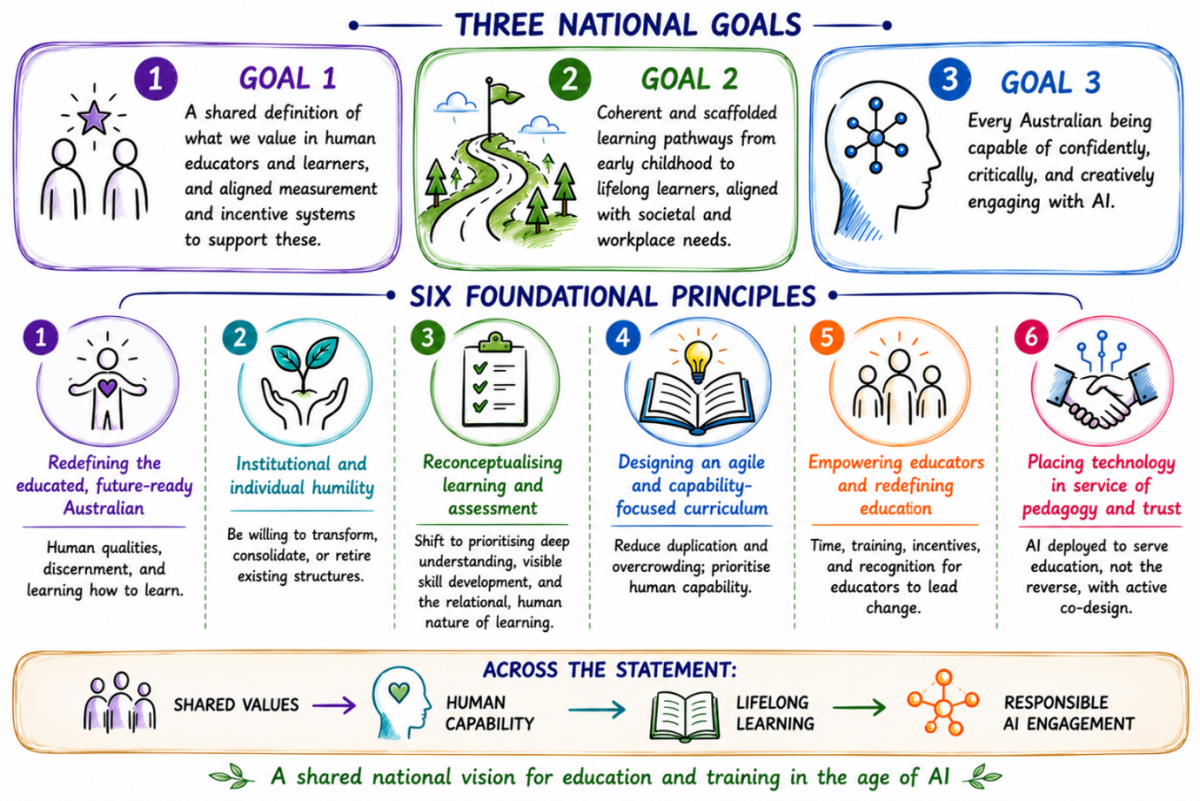
Professors Lodge and Palmer highlighted the essential role of educators within this transformation. In an AI-enabled education system, educators are not peripheral to change; they are central to determining its educational purpose. Empowering educators requires more than expecting them to accommodate successive waves of technological change. It requires time, capability development, appropriate incentives and recognition, alongside the professional agency to exercise informed educational judgement
At the heart of the discussion was a fundamental tension: many of our education and training systems were designed for an era in which information and cognitive labour were comparatively scarce. Generative AI disassembles that premise, while established educational structures continue to privilege information transmission and the reproduction of knowledge. Jason and Edward encouraged participants to examine assumptions that have remained largely unquestioned for decades: how we recognise meaningful learning, and whether existing educational approaches remain fit for purpose.
If the conditions surrounding knowledge are changing, what should education enable learners to know, understand, critique, create and become?
Viewed through this lens, AI becomes more than a source of disruption. It becomes a welcome catalyst for a deeper examination of education itself.
What next?
The Castlereagh Statement is currently a Green Paper. It establishes direction rather than presenting a completed blueprint. Its three horizons envisage movement from shared national foundations, through system-wide infrastructure, towards longer-term transformation across the education ecosystem.
Crucially, as Professor Lodge and Professor Palmer emphasised, “the architecture must be built together.”
That proposition transforms the Statement from a document into an invitation. The next step is for the Statement to become a white paper with recommendations and a roadmap for a successful pathway to an AI-enabled future. The future of education cannot be determined by individual institutions or experts acting in isolation. Educators, learners, schools, vocational education, universities, industry, the community and government all have a role in shaping what comes next.
Fittingly, the workshop concluded not with a definitive answer, but with an invitation to contribute: to connect, extend the conversation and consider what concrete action might begin now.
Perhaps this is where the Castlereagh Conversation is most powerful. We cannot know precisely what education will look like in twenty years’ time. We can, however, decide what we value enough to carry forward, what we have the courage to reconsider, and what we are prepared to build together.
You can join the Castlereagh discussions by visiting https://castlereagh.ai
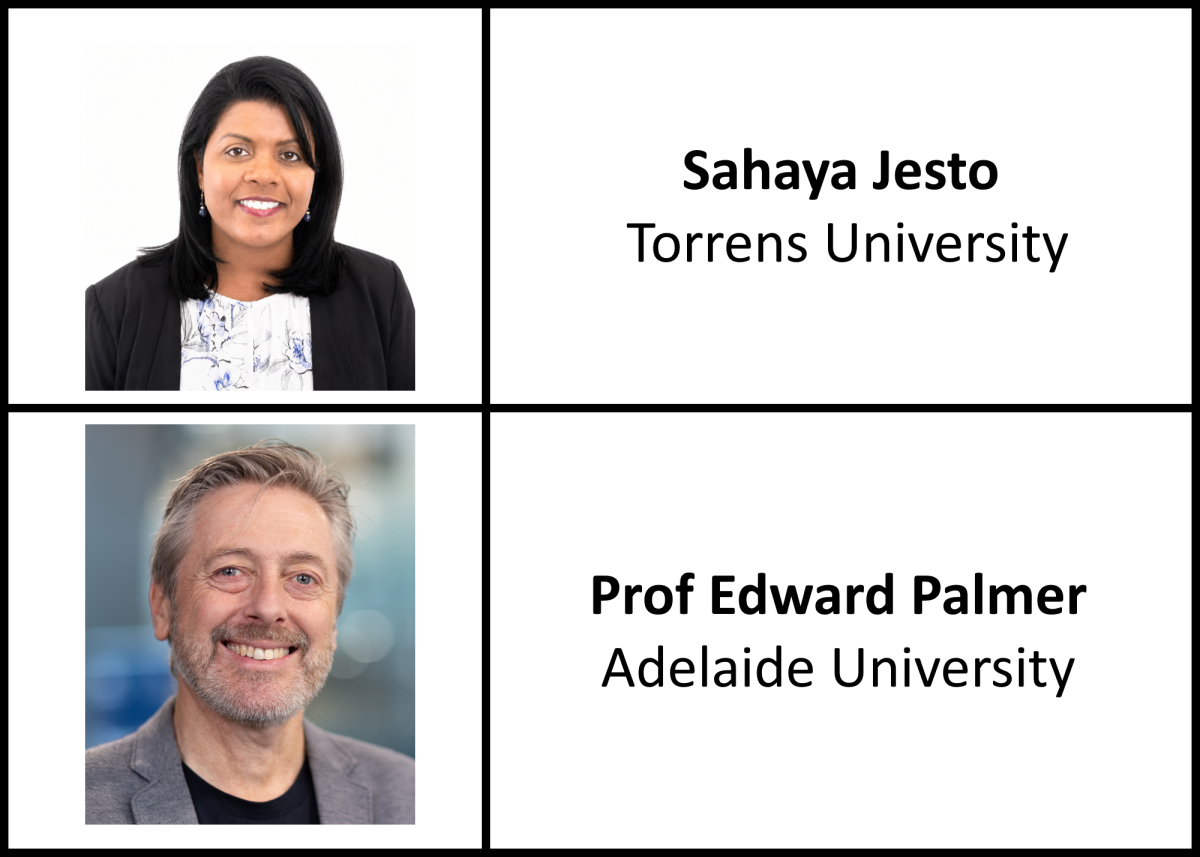
Blog Authors:
Images and banner image (ChatGPT) were generated with AI
About the author

Sahaya Jesto
Recent Posts
The HERDSA Connect Blog offers comment and discussion on higher education issues; provides information about relevant publications, programs and research and celebrates the achievements of our HERDSA members.
HERDSA Connect links members of the HERDSA community in Australasia and beyond by sharing branch activities, member perspectives and achievements, book reviews, comments on contemporary issues in higher education, and conference reflections.
Members are encouraged to respond to articles and engage in ongoing discussion relevant to higher education and aligned to HERDSA’s values and mission. Contact Daniel Andrews Daniel.Andrews@herdsa.org.au to propose a blog post for the HERDSA Connect blog.
HERDSA members can login to comment and subscribe.