Higher Education Research and Development Society of Australasia

You are here
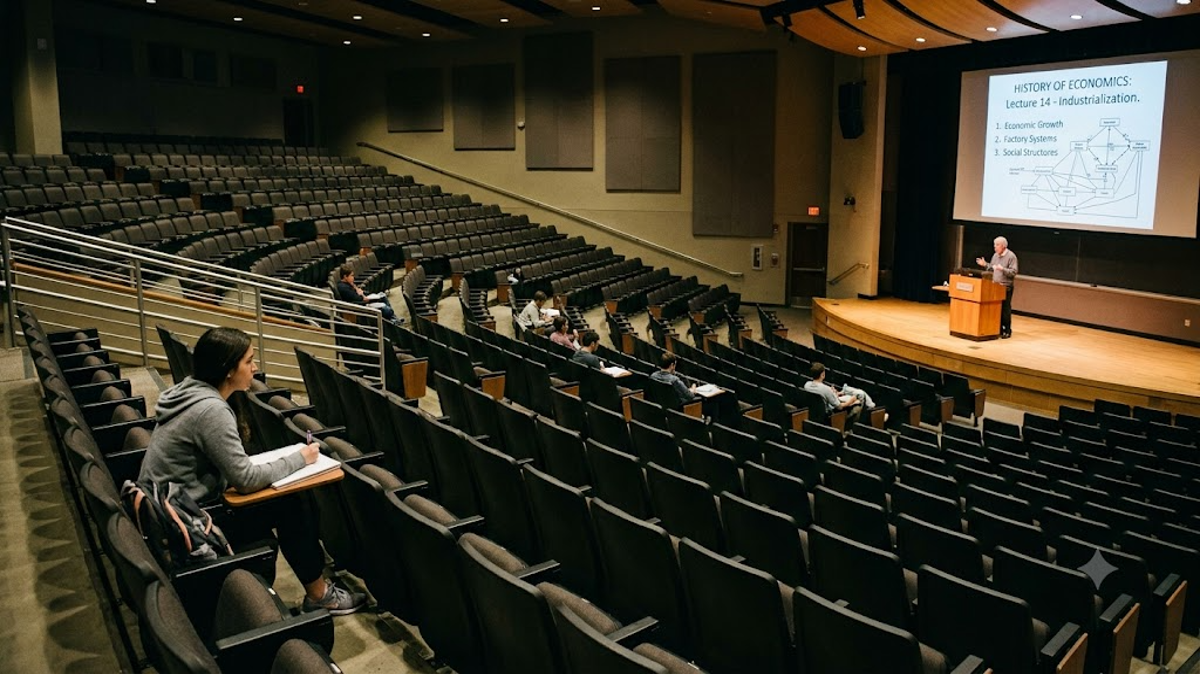
In one of our seminars this year, five students stood out. They came every week, prepared, asked questions, did the work. In a room where most seats were empty, they were impossible to ignore. They were all from Chinese families — children of immigrants, raised in Spain but shaped by the values their parents had brought with them. Every classmate had the same internet access, the same AI tools, the same lecture slides. The conditions were identical. The behaviour was not.
That gap is, I’d argue, the most instructive thing happening in European universities right now.
The AI explanation doesn’t hold up
The story we keep hearing is this: generative AI has given students a substitute for lectures, so they’ve stopped coming. It’s a neat narrative. It’s also almost certainly wrong.
The timing alone should give us pause. Absenteeism and disengagement surged in 2020, during the pandemic and the shift to online learning. ChatGPT didn’t arrive until November 2022 — two years later. A cause can’t follow its effect. The RAND Corporation’s 2025 report on chronic absenteeism confirms the trajectory: chronic absence rates jumped to 28.5% in 2021–22 and, despite some recovery, remain well above pre-pandemic levels.
The behaviour of students who skip class undermines the AI thesis further. If AI were replacing the effort of attending, you’d expect students to at least use it to prepare for seminars. They don’t. Students who skip lectures also arrive at seminars having read nothing and prepared nothing. And the correlation between attendance and grades? Still intact. Students who come do better; students who don’t do worse. AI is not providing an effective substitute.
What the pandemic actually did
The pandemic didn’t just disrupt education. For a generation who spent formative years in lockdown, it broke something more fundamental: the belief that sustained effort has value. Jean Twenge’s analysis of the long-running Monitoring the Future study is striking — the proportion of 18-year-olds willing to work extra hours fell from 54% at the start of 2020 to 36% in 2022, the lowest in the study’s 46-year history. This wasn’t a gradual decline. It was an abrupt rupture.
Research on mortality salience helps explain why. Younger generations experienced significantly higher levels of existential anxiety during the pandemic than older adults, despite being less physically at risk. When death feels vivid and close, long-term investments (like a four-year degree) start to feel abstract and remote.
Why culture matters
This brings us back to those five students. They faced the same pandemic their classmates did. What differed was the cultural framework passed down within their families: one where effort is a moral obligation, not a personal choice, and where setbacks are attributed to insufficient application rather than insufficient ability. When that framework is present, external disruptions don’t fundamentally change behaviour.
How universities made things worse
Over the past two decades, with genuinely good intentions, universities have systematically removed friction from learning: slides replaced notetaking, recordings replaced attendance, group work reduced individual accountability. Research published in BMC Medical Education confirms that students who take notes by hand show significantly higher cognitive performance than those using digital methods, because the effort of paraphrasing in real time is the learning. When that effort disappears, so does much of the benefit of attending.
There’s also a perverse incentive problem. In many institutions, academics who maintain high standards receive lower student evaluations and face implicit pressure to lower the bar. The system rewards accommodation. Each individual concession seems reasonable; the collective result is a race to the bottom.
So, what can we actually do?
The uncomfortable conclusion is that this isn’t a pedagogical problem with a pedagogical fix. Rebuilding a generation’s relationship with effort is a different order of challenge, and universities didn’t cause it and can’t fix it alone.
But what academics can do is resist the institutional logic of infinite accommodation. Maintaining genuine standards, refusing to make absence consequence-free, and insisting that learning requires effort are not reactionary positions. Right now, they’re quietly countercultural ones.
Are you seeing similar patterns in your own institution? Have you found approaches that genuinely rebuild student engagement, rather than simply accommodating its absence? We’d love to hear from you. Share your experiences in the comments below or get in touch with the authors directly.
Blog Authors:

Banner image created with Google Gemini
About the author

Elena Liquete
Recent Posts
The HERDSA Connect Blog offers comment and discussion on higher education issues; provides information about relevant publications, programs and research and celebrates the achievements of our HERDSA members.
HERDSA Connect links members of the HERDSA community in Australasia and beyond by sharing branch activities, member perspectives and achievements, book reviews, comments on contemporary issues in higher education, and conference reflections.
Members are encouraged to respond to articles and engage in ongoing discussion relevant to higher education and aligned to HERDSA’s values and mission. Contact Daniel Andrews Daniel.Andrews@herdsa.org.au to propose a blog post for the HERDSA Connect blog.
HERDSA members can login to comment and subscribe.