Higher Education Research and Development Society of Australasia

You are here

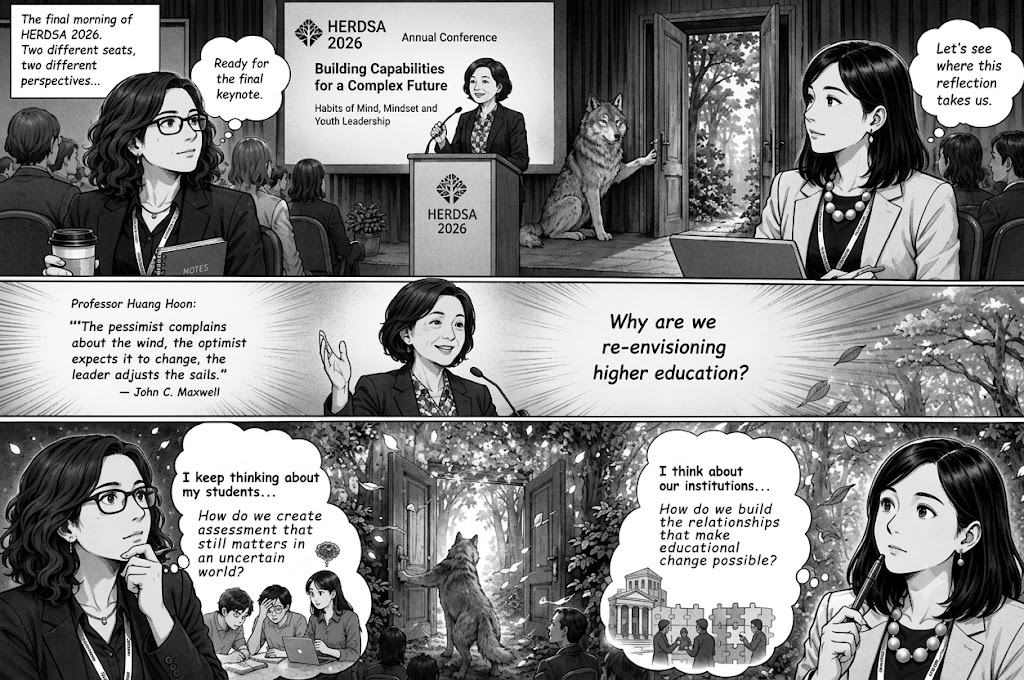
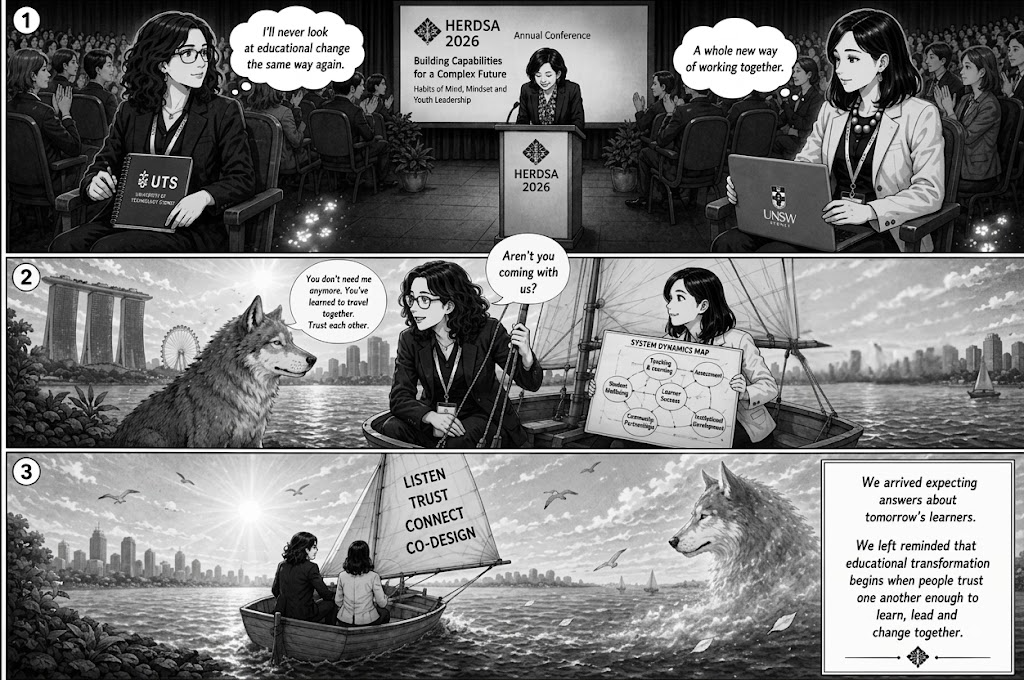
One of the things we value most about HERDSA is that the conversations rarely end when the keynote does. Some of the most meaningful insights emerge afterwards, over coffee, between sessions, or long after everyone has returned home. That was certainly our experience after Professor Huang Hoon's keynote, Building Capabilities for a Complex Future: Habits of Mind, Mindset and Youth Leadership, on the last day of HERDSA 2026.
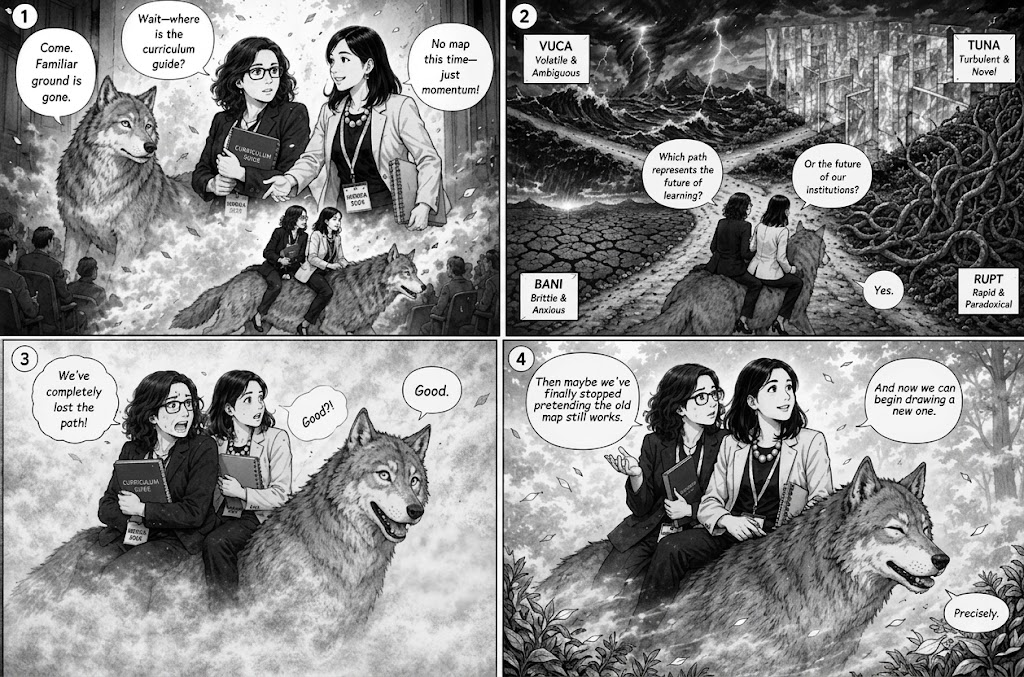
Using the grey wolf as a metaphor for uncertainty, Professor Chng challenged us to think less about predicting the future and more about developing the capabilities needed to navigate it. Drawing on Arthur Costa and Bena Kallick's Habits of Mind, she encouraged us to cultivate systems thinking, empathy, curiosity and leadership as ways of responding to complexity rather than avoiding it.
As we reflected together, we realised we had each been listening through different professional perspectives. Amanda focused on students, learning and assessment, while Diana focused on institutions, relationships and the organisational conditions that make educational change possible. We left the keynote asking different questions. The more we talked, the more we realised our questions were complementary ways of understanding the same educational challenge.
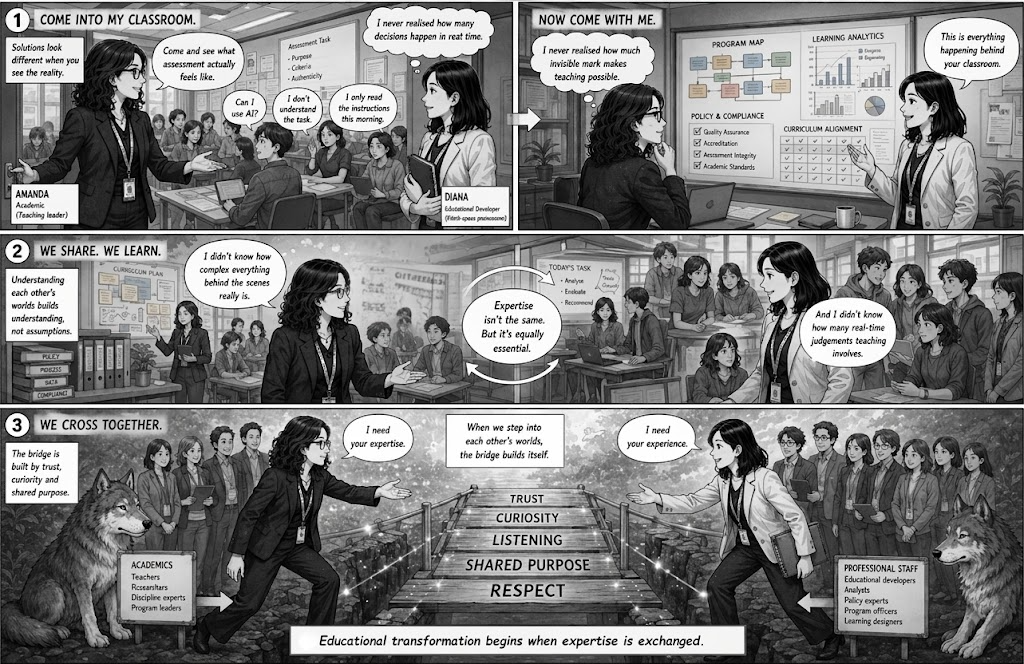
The comic that follows captures this shared journey of reflection.
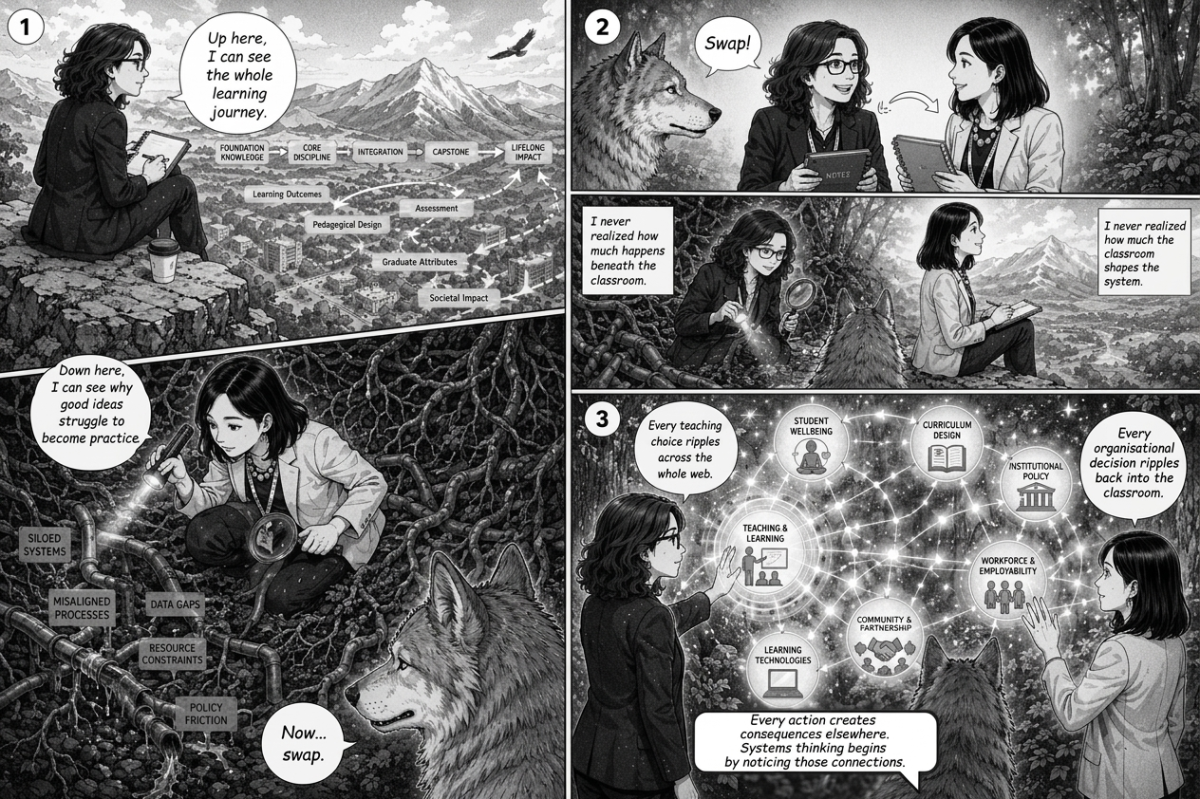
Seeing the same landscape differently
We initially interpreted bird's-eye and worm's-eye views as representing academic and third space perspectives. The more we talked, the more we realised that the metaphor was richer than that.
Both academics and third space professionals move between strategic and operational perspectives. What differs is the part of the educational system we notice most readily. Amanda focused on classroom experiences, assessment and graduate outcomes, while Diana focused on program design, institutional systems and implementation.
Exchanging those perspectives revealed relationships that neither of us could fully appreciate alone. That insight resonated strongly with systems thinking, reminding us that educational change is best understood through the relationships between interconnected parts. That thinking in this way aims to also minimise negative unintended consequences – reducing problems or challenges we may have to address ex-post.
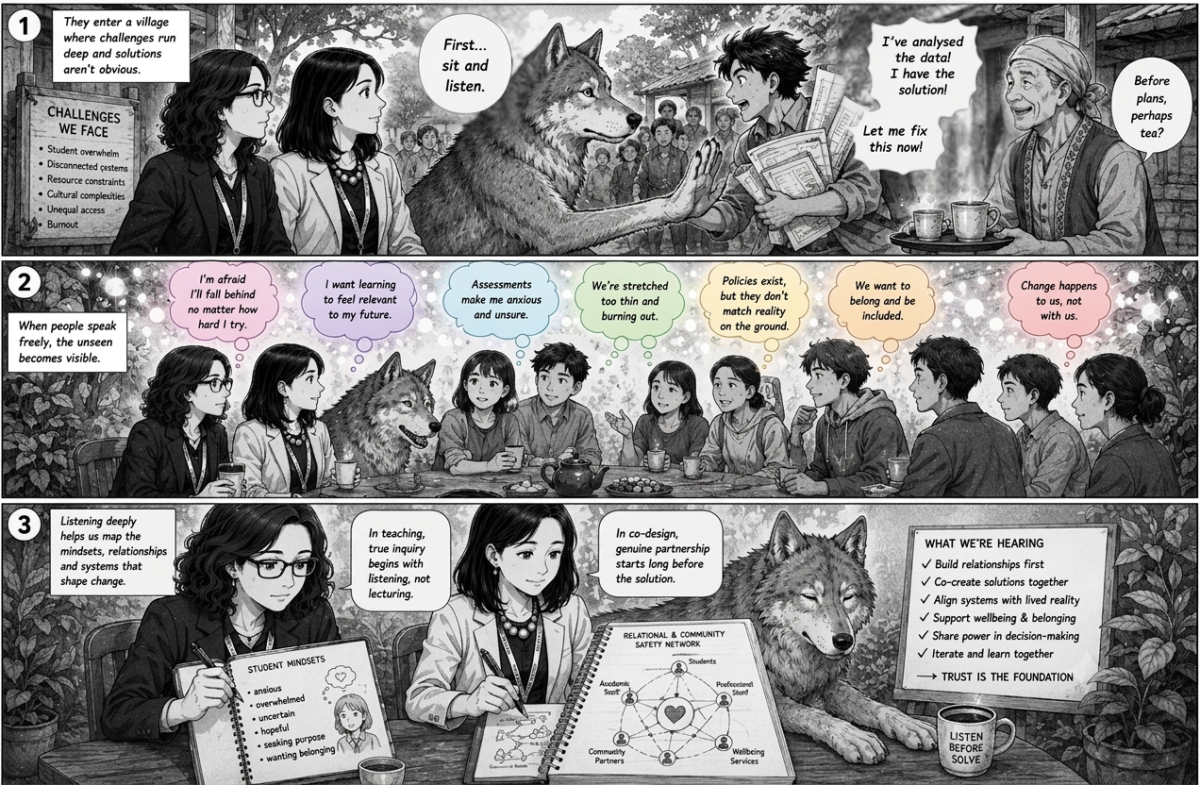
Listening before solving
Professor Huang Hoon described how engineering students sought to understand stakeholders' realities before attempting to design solutions. Rather than beginning with answers, they began with questions.
As we translated that idea into the comic, we imagined an enthusiastic engineer rushing into a village carrying blueprints, eager to solve everyone's problems. Before he can begin, the grey wolf quietly raises a paw and says, "First... sit and listen."
Faced with complex challenges, our instinct is often to move quickly towards solutions. Yet meaningful educational transformation begins with understanding.
Listening creates the trust that allows academics and third space professionals to understand each other's realities, share expertise and work towards meaningful change together. This reflects contemporary thinking about relational third space practice, where collaboration depends less on organisational structures than on dialogue, reciprocity and shared expertise.
Building the bridge
Initially, we envisioned the bridge as a connection between academics and third space professionals. As our conversation unfolded, we realised that the bridge was never really about organisational boundaries. It was about creating the conditions for expertise to move freely across them.
Academics understand the lived realities of teaching, assessment and student learning. Third space professionals understand the institutional conditions that enable those experiences to flourish. Neither perspective is sufficient on its own.
The bridge emerged when we stopped asking, "How do we connect our roles?" and started asking, "What can we learn from each other's expertise?" This shift transformed the bridge from a symbol of collaboration to a symbol of shared learning.
This understanding reflects the growing shift from service to partnership, where collaboration is built on reciprocity, shared expertise, mutual respect and trust rather than organisational roles alone. Higher education will not be able to do the work we need to do now, and in the future, effectively without leaning into partnership.
Our reflection
The grey wolf quietly disappears at the end of the comic. The uncertainty does not. Neither do the challenges facing higher education. What changes is how we choose to respond.
We arrived at the keynote expecting ideas about tomorrow's learners. We left with a deeper appreciation of the different forms of expertise needed to navigate educational transformation. The grey wolf reminds us that uncertainty is inevitable. Our conversation afterwards reminded us that meaningful change becomes possible when we are willing to learn from each other.
An invitation
Every institution has its own grey wolf. Whatever form it takes, perhaps the next step is not another framework or policy, but an invitation.
An academic inviting a third space colleague into the classroom.
A third space professional inviting an academic into program design.
A willingness to see the educational landscape through someone else's eyes.
We hope this comic becomes part of that conversation.
Blog Authors:
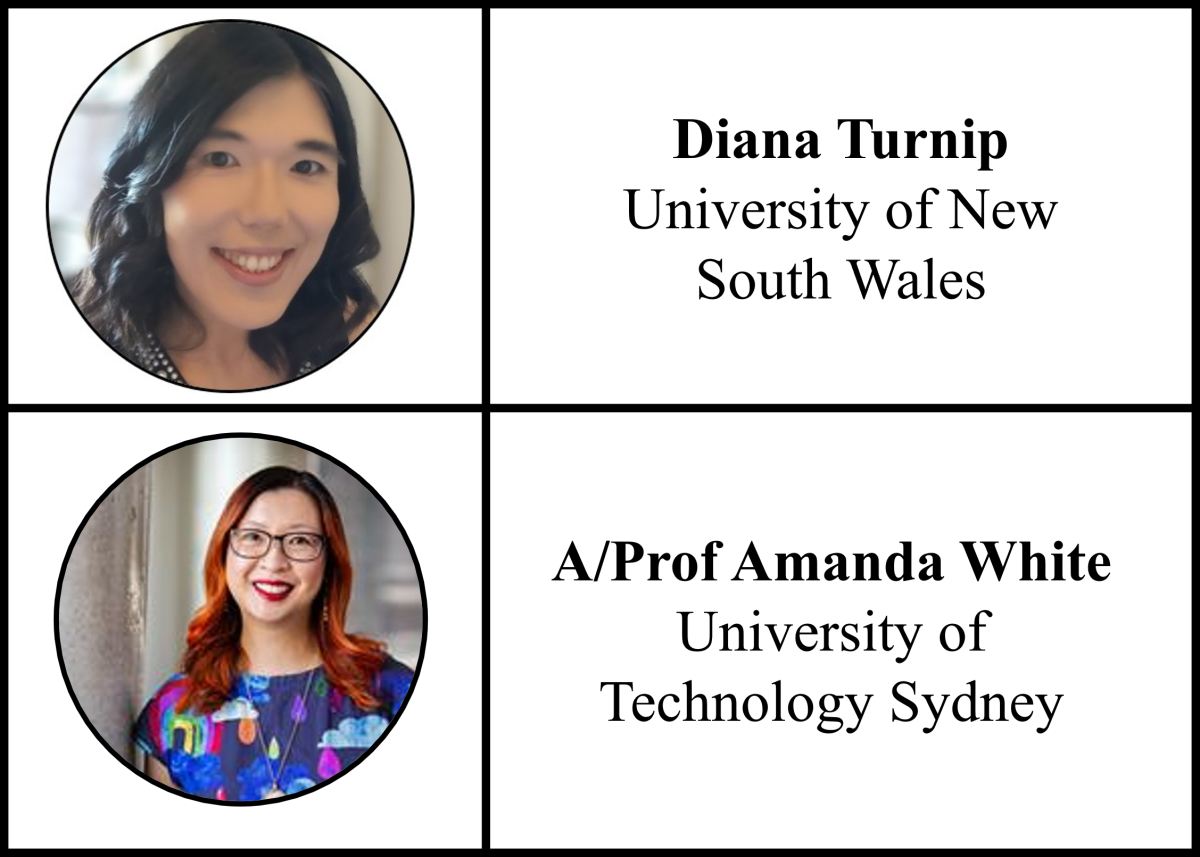
The comic illustrations were created using ChatGPT Edu (OpenAI), based on prompts, storyboards and iterative direction developed by the authors. The narrative, interpretations and written content were developed by the authors, who also reviewed and refined the AI-generated images.
About the author

DianaTurnip
Recent Posts
The HERDSA Connect Blog offers comment and discussion on higher education issues; provides information about relevant publications, programs and research and celebrates the achievements of our HERDSA members.
HERDSA Connect links members of the HERDSA community in Australasia and beyond by sharing branch activities, member perspectives and achievements, book reviews, comments on contemporary issues in higher education, and conference reflections.
Members are encouraged to respond to articles and engage in ongoing discussion relevant to higher education and aligned to HERDSA’s values and mission. Contact Daniel Andrews Daniel.Andrews@herdsa.org.au to propose a blog post for the HERDSA Connect blog.
HERDSA members can login to comment and subscribe.