Higher Education Research and Development Society of Australasia

You are here

Conferences can be exciting, inspiring and professionally rewarding. They can also be overwhelming, particularly for first-time attendees, those travelling alone, or people entering a new community. While conference programmes usually include social opportunities for networking, making those first connections is often the hardest part.
Finding Your Place
The HERDSA Buddy Programme was established to make this process a little easier. Before the conference, first-time delegates are connected with a small group of other new peers and an experienced delegate. This way, a virtual community has been set up before the travel.
While without prescribing many rules, this programme was meant to be friendly and free style. The idea is simple: create a welcoming point of connection that helps people feel part of the HERDSA community from the very beginning.
At first glance, it might seem like a small initiative. Yet, as we discovered, a simple introduction can become something much more meaningful.
What Happens When We Become the Students?
As academics we spend a lot of time focused on the student experience. Strengthening engagement, encouraging participation and facilitating connection is all part of our daily work.
What happens when we become the students?
Being a first-time attendee at a HERDSA conference is not unlike turning up to a lecture or tutorial on day one. Many people you don’t know, from places you may never have been, and everyone seems to know each other already.
This is why the HERDSA buddy programme is so valuable.
A Simple Introduction to Something More
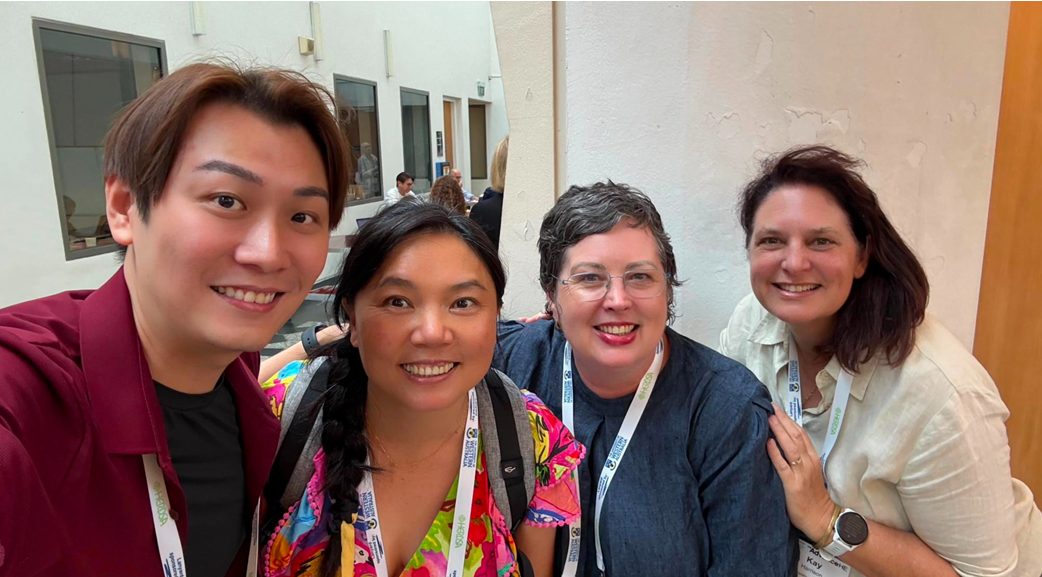
Connected randomly (or was it by fate?), the four of us came together from different backgrounds, levels of experience and from vastly different geographies. Academic work can be notoriously siloed. We often operate within the narrow confines of our own departments and immediate institutional contexts, rarely seeing beyond our own campus walls. Stepping outside those institutional echo chambers and discovering how counterparts across Australia, New Zealand, and Singapore tackle similar pedagogical challenges was deeply refreshing. Our initial pre-conference Zoom call began as a cautious conversation to see whether these relative strangers would become support systems or friends. What we found was far more than just familiar faces in a crowded room. Going into the buddy programme, we might have expected some polite interaction, a familiar face in the crowd. But what we got was so much more.
What we shared was a willingness to put ourselves out there and reach out to people we don’t already know – the same willingness we ask of our students. We swapped showcase and presentation times and agreed to meet at breakfast, so we didn’t have to walk into our first sessions alone.
In the hyper intense three-day conference time connections are accelerated. We weaved our tapestry of jokes, stories, and histories together at warp speed. Our HERDSA buddies became our cheer squad, our shared rides to and from our hotel, a welcoming lunch partner and a discussion group to question ideas and test theories.
From Buddies to Community
Creating community is not rocket science – you lay the foundations, provide some structure and invite the people. While we all have professional careers that involved varying experience of conference participation, this was the first time the three new HERDSA attendees had participated in such a programme. Were we just lucky to find three others willing to be just a bit vulnerable or are we one group of many that became instant friends?
Speaking to another delegate early in the conference, we were asked how do you find collaborators and research partners? Our answer was through conferences and communities like these. They are a place where you can find ‘your people’, future writing partners and even future jobs. The challenge is to make the approach, and the HERDSA buddy programme gave us a sense of security that comes with having people on your side.
Creating More Welcoming Conferences
For conference organisers – we encourage you to continue to create these spaces that do not feel exclusive, to welcome new members to your broader community, essential to creating vibrant groups. Invite people (new and potential delegates) to participate in introduction and connection events leading towards the conference. For example, the new buddies in our group did not know what TATAL stood for and we met so many TATALers during the conference. (Note – it’s Talking About Teaching And Learning and it took one of us until day three to find this out.)
For future conference delegates – take the opportunity to become a buddy, remember this anxious feeling and embrace being a student and connecting with new people.
For us, what comes of this group is still to be seen. We’ve already extended beyond the boundaries of the conference by collectively writing this post. We’ve also shared research and offered ongoing mentoring and advice.
We might have higher degrees and grown-up jobs, but our needs and worries are not that different from those we welcome each semester. What the HERDSA buddy programme shows is that it just takes a little nudge, a small process, to help build a community.
A Small Nudge, A Powerful Impact
The experience also reminded us of something that is easy to forget in higher education. While conferences are often viewed as places to share research, they are equally places where professional identities, collaborations and communities are formed. Many of the research projects, publications and friendships that shape academic careers begin with a conversation over coffee, a shared meal or a chance introduction.
The HERDSA Buddy Programme creates opportunities for these conversations to happen. It lowers the barriers to participation, helps newcomers feel welcome and strengthens the collegial spirit that many of us value within the HERDSA community.
For a programme built on a simple premise, its impact can be surprisingly powerful. Sometimes finding your place in a community starts with nothing more than being introduced to a few strangers and discovering they might become colleagues, collaborators and friends.
Blog Authors:
Kim Goodwin, the University of Melbourne, Australia (second from the right)
Dongmei Li, James Cook University, Australia (second from the left)
Kay Harrison, Auckland University, New Zealand (far right)
Tony Goh, National University of Singapore, Singapore (far left)
About the author

Dongmei Li
The HERDSA Connect Blog offers comment and discussion on higher education issues; provides information about relevant publications, programs and research and celebrates the achievements of our HERDSA members.
HERDSA Connect links members of the HERDSA community in Australasia and beyond by sharing branch activities, member perspectives and achievements, book reviews, comments on contemporary issues in higher education, and conference reflections.
Members are encouraged to respond to articles and engage in ongoing discussion relevant to higher education and aligned to HERDSA’s values and mission. Contact Daniel Andrews Daniel.Andrews@herdsa.org.au to propose a blog post for the HERDSA Connect blog.
HERDSA members can login to comment and subscribe.