Higher Education Research and Development Society of Australasia

You are here
HERDSA recently brought colleagues from across the higher education sector together for a sector engagement workshop exploring the Castlereagh Statement and its implications for AI, education and society.
Facilitated by Professor Edward Palmer and Professor Danny Liu, the workshop provided an opportunity to explore the Castlereagh Statement as a starting point for a broader conversation about what we value in education, the capabilities learners need, and how education and training systems might respond to an AI-enabled future. The session followed strong interest in the Castlereagh discussion at the HERDSA 2026 Conference in Singapore.
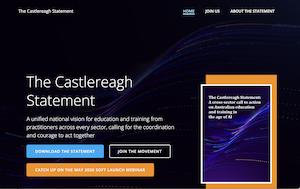
The Castlereagh Statement is currently a green paper open for consultation, seeking to develop a shared national vision for Australian education and training in the age of AI. The discussion introduced its three goals, six foundational principles and three horizons for action, with a strong emphasis on human capabilities, meaningful learning, educator empowerment, responsible use of technology, and placing technology in service of pedagogy.
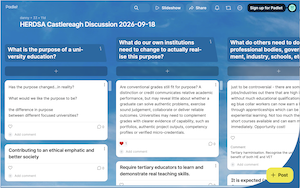
A key feature of the workshop was the opportunity for participants to contribute directly through a Padlet discussion. Three questions invited participants to consider:
- What is the purpose of a university?
- What do individuals and institutions need to do differently?
- What needs to change across the wider education and training ecosystem?
The discussion highlighted several interconnected themes. Participants reflected on the importance of human formation, adaptability, lifelong learning, critical thinking, creativity and the development of the whole person, alongside the continued importance of foundational knowledge and disciplinary capabilities.
Assessment emerged as a particularly significant area for reflection. Participants questioned whether current assessment practices, grading approaches and incentive structures are sufficiently aligned with the capabilities we want learners to develop. The conversation also explored how assessment might place greater emphasis on learning processes, capability development, creativity, collaboration and meaningful application rather than simply the production of a final product.
The role and conditions of educators were another strong theme. Participants highlighted the need for professional learning, institutional support, collaboration, flexibility, appropriate incentives and psychologically safe environments that enable educators to experiment, learn from mistakes and develop new approaches to curriculum and assessment.
The conversation also reinforced the importance of student voice and cross-sector collaboration. Participants discussed the need to engage students meaningfully in conversations about AI and education, including students from different disciplines, age groups and stages of learning. The interconnected nature of education was also emphasised, with higher education positioned as one part of a broader ecosystem involving schools, VET, industry, professional bodies, government and the community.
A recurring question throughout the discussion was how we create greater alignment between what we value, what we teach, how we assess, what institutions enable, and what the sector recognises and rewards.
The workshop demonstrated the value of continuing this conversation collectively. HERDSA thanks Professor Edward Palmer, Professor Danny Liu and all participants who contributed their perspectives, questions and ideas to this important sector dialogue.
The conversation does not end with the workshop. The Castlereagh Statement remains open for consultation, and colleagues are encouraged to read the statement, contribute their perspectives and share the conversation with their networks.
Find out more and contribute: Castlereagh Statement
Continue the HERDSA discussion: HERDSA Castlereagh Discussion Padlet
Access the workshop recording here: https://youtu.be/6kjYQbhCSug